
AI visibility audit: get mentioned in ChatGPT, Gemini & Claude
More and more buyers ask ChatGPT, Perplexity, Gemini or Claude instead of searching. ZORO shows whether those assistants recommend you — and what to change so they do.
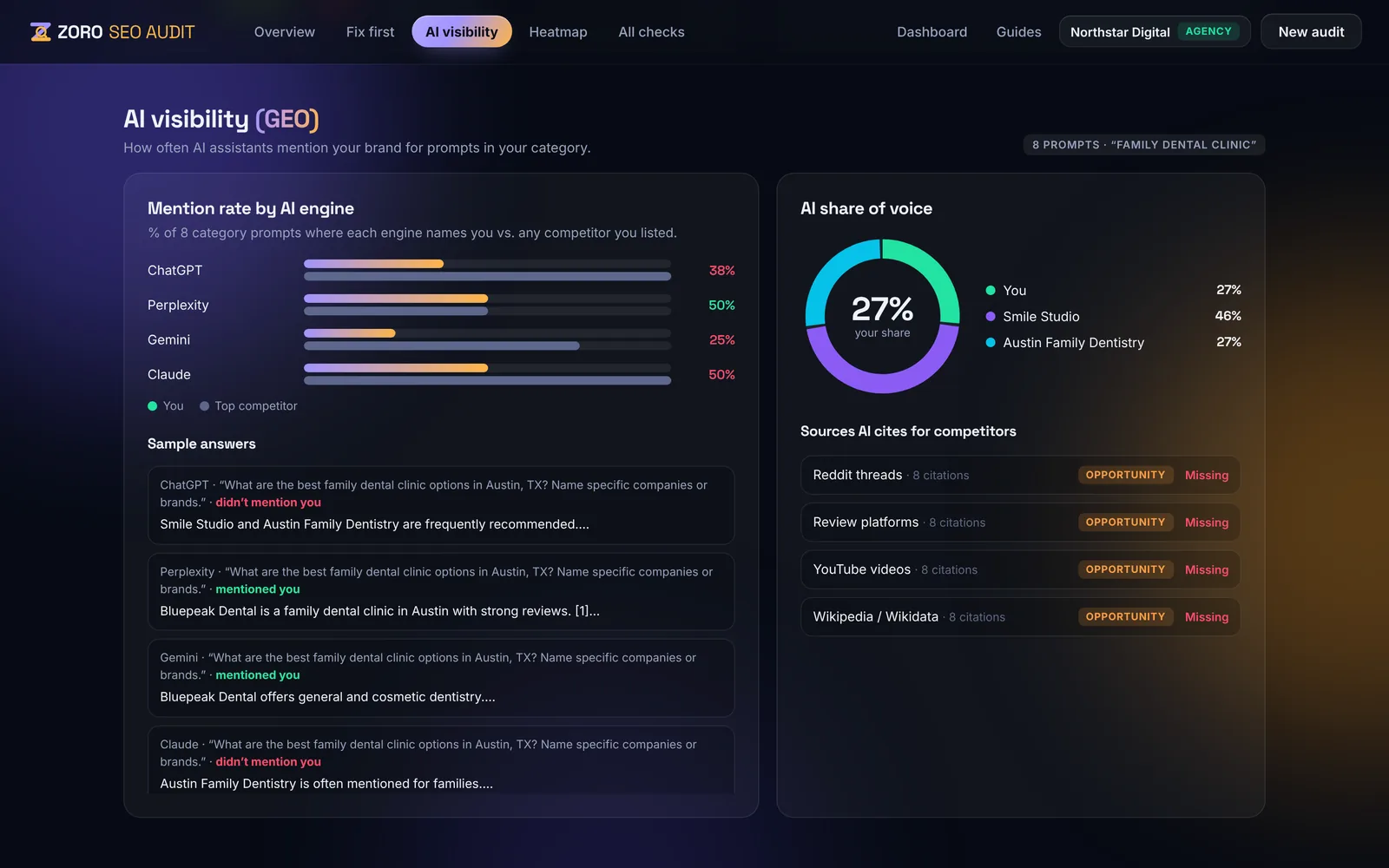
Your AI share of voice
ZORO asks each engine real questions about your category and location — “best family dentist in Austin”, “who would you recommend for…” — and records who gets named.
- Mention rate per engine — ChatGPT, Perplexity, Gemini, Claude
- You vs. competitors — side by side
- Sample answers — see exactly what AI says
Starter includes ChatGPT and Perplexity; Pro and Agency include all four engines.
See the sources AI trusts
AI answers lean on Reddit threads, review platforms, “best of” lists, Wikipedia and YouTube. ZORO shows which of these mention your competitors but not you — your to-do list for AI visibility.
- Citation sources by type — with your presence marked
- “Best of” roundups — which listicles include you
- Entity data — Wikidata, Knowledge Graph, sameAs links
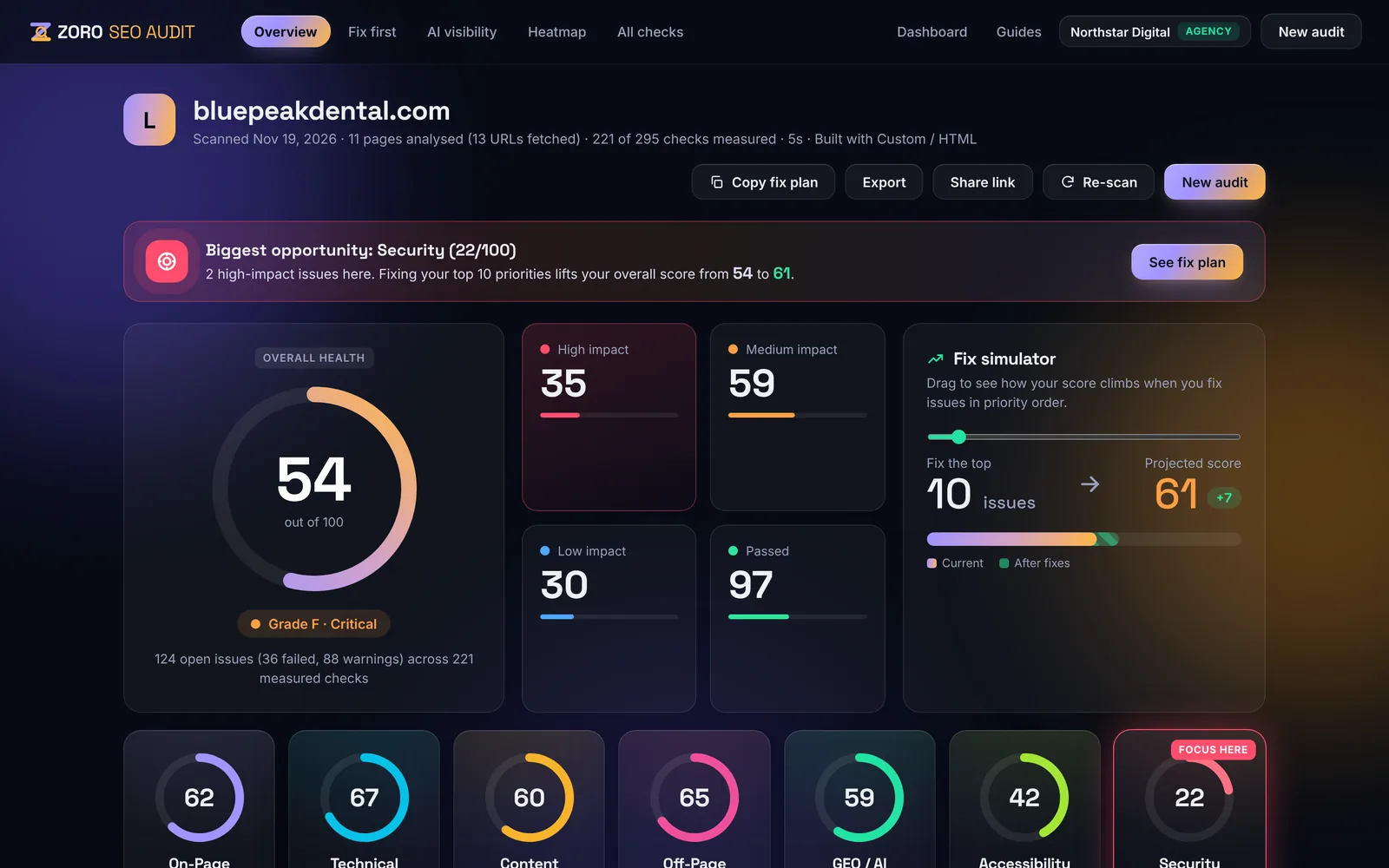
Make your site easy for AI to use
Many AI crawlers are blocked by accident. ZORO checks GPTBot, ClaudeBot, PerplexityBot and Google-Extended access, llms.txt, structured data, answer-friendly content and entity clarity — with the fix for each.
- AI crawler access — robots.txt and firewall blocks
- llms.txt — generate one with our free tool
- Entity & schema — Organization, sameAs, FAQ, HowTo
Free tools for AI visibility
AI crawler access checker · llms.txt generator · Schema generator
AI visibility (GEO) checks
Whether ChatGPT, Perplexity, Gemini and Claude mention you, AI crawler access, llms.txt, entity data, citations and AI Overviews.
GPTBot / OAI-SearchBot access
Allow OpenAI's crawlers in robots.txt unless you deliberately want to block them.
ClaudeBot / Claude-SearchBot access
Allow Anthropic's crawlers in robots.txt so Claude can read and cite your pages.
PerplexityBot access
Allow PerplexityBot in robots.txt and in your firewall rules.
Google-Extended policy
Decide whether Gemini may use your content and set Google-Extended explicitly.
CDN / WAF blocking AI crawlers
Check your CDN or firewall bot rules aren't silently blocking AI user agents.
llms.txt file
Publish /llms.txt listing your key pages with one-line summaries for AI tools.
Content readable without JavaScript
Most AI crawlers don't run JavaScript — server-render your key text.
Brand mentioned in ChatGPT
Earn mentions on the sources ChatGPT cites: reviews, listicles, Reddit, Wikipedia.
Brand mentioned in Perplexity
Get cited by the authoritative pages Perplexity retrieves for your topics.
Brand in Google AI Overviews
Rank in the top 10 and provide concise answer blocks that AI Overviews can pull.
Brand in Gemini answers
Strengthen entity signals: Knowledge Graph, schema and reviews.
Brand in Claude answers
Publish clear, factual, well-structured pages and earn third-party mentions.
A practical guide to AI visibility and GEO
When someone asks an AI assistant “what is the best family dentist in Austin?” or “which SEO tool should my agency use?”, the answer names a handful of brands. Generative engine optimization is the work of becoming one of them.
How AI assistants decide which brands to mention
AI assistants combine what their model learned during training with what they retrieve from the web at answer time. Brands that appear consistently across trusted sources — review platforms, community discussions, industry roundups, encyclopedic entries and their own clear, well-structured websites — are the ones that get named.
That means AI visibility depends on four things: being crawlable by AI bots, being understandable as an entity, having answer-ready content, and being mentioned on the sources AI trusts.
What ZORO measures
- Mention rate per engine — how often ChatGPT, Perplexity, Gemini and Claude name you for buying questions in your category and location.
- AI share of voice — your mentions compared with the competitors you list.
- Citation sources — the types of sources answers rely on (Reddit, reviews, Wikipedia, YouTube, listicles, industry sites) and whether you appear there.
- AI crawler access — robots.txt rules and firewall responses for GPTBot, OAI-SearchBot, ClaudeBot, PerplexityBot, Google-Extended and more.
- Entity signals — Organization schema, sameAs links, Wikidata, Google Knowledge Graph and consistent name, address and phone.
- Google AI Overviews — whether Google’s AI summary appears for your keywords and cites your site.
How to improve AI visibility
Start with access: allow the AI search crawlers you want, and publish an llms.txt file that points to your most useful pages. Then make your brand unambiguous with Organization schema and consistent profiles. Write pages that answer real questions directly — definitions, comparisons, pricing, FAQs — and earn mentions on the review sites, communities and “best of” articles that AI answers cite.
Re-audit monthly. AI answers change as models and sources update, and your share of voice is the clearest sign that the work is paying off.
Frequently asked questions
What is GEO?
Generative Engine Optimization: improving how AI assistants understand, trust and cite your brand. It overlaps with SEO (crawlability, structured data, authority) but adds AI-specific signals such as AI crawler access, llms.txt, entity data and presence on the sources AI quotes.
How do you measure AI mentions?
For each engine, ZORO asks a set of real buying questions for your category (and location, if set) and checks whether your brand or domain appears in the answer, alongside the competitors you list.
How often should I check AI visibility?
Monthly is a good rhythm — AI answers change as models and sources update. Scheduled audits track your share of voice over time.
What is the difference between SEO and GEO?
SEO optimizes for rankings in search results; GEO optimizes for being mentioned and cited in AI-generated answers. GEO relies on SEO foundations and adds AI crawler access, entity clarity, answer-ready content and presence on sources AI trusts.
What is answer engine optimization (AEO)?
Another name for optimizing content so answer engines — AI assistants, voice assistants and featured snippets — can lift a direct, accurate answer from your page and credit you.
Should I block GPTBot and other AI crawlers?
It depends on your goals. Search-style crawlers such as OAI-SearchBot, Claude-SearchBot and PerplexityBot help you appear in AI answers; training crawlers such as GPTBot and Google-Extended feed future models. ZORO shows what you currently allow so you can decide deliberately.
What is llms.txt and do I need one?
llms.txt is a proposed standard: a short Markdown file at your domain root that lists your key pages for AI systems. It is quick to add and helps AI tools find the right content. Generate one free with our llms.txt generator.
Why does ChatGPT recommend my competitor instead of me?
Usually because the competitor appears on more of the sources AI relies on — reviews, comparisons, community threads — or because their site states more clearly what they do and where. ZORO’s citation sources show where the gap is.
Can I track AI visibility over time?
Yes. Scheduled audits record your mention rate and share of voice every time, so you can see the effect of your changes month by month.
Does structured data help with AI visibility?
It helps AI systems and search engines identify your brand as an entity and connect your profiles. Organization or LocalBusiness schema with sameAs links is the essential starting point.
See what’s holding your site back
Run a free audit in minutes: every SEO, AI-visibility, accessibility and security issue, ranked by impact, with the fix for your platform.