
Security checks that protect trust
Browsers warn visitors, Google prefers secure sites, and attackers look for easy wins. ZORO checks the security basics every website should get right.
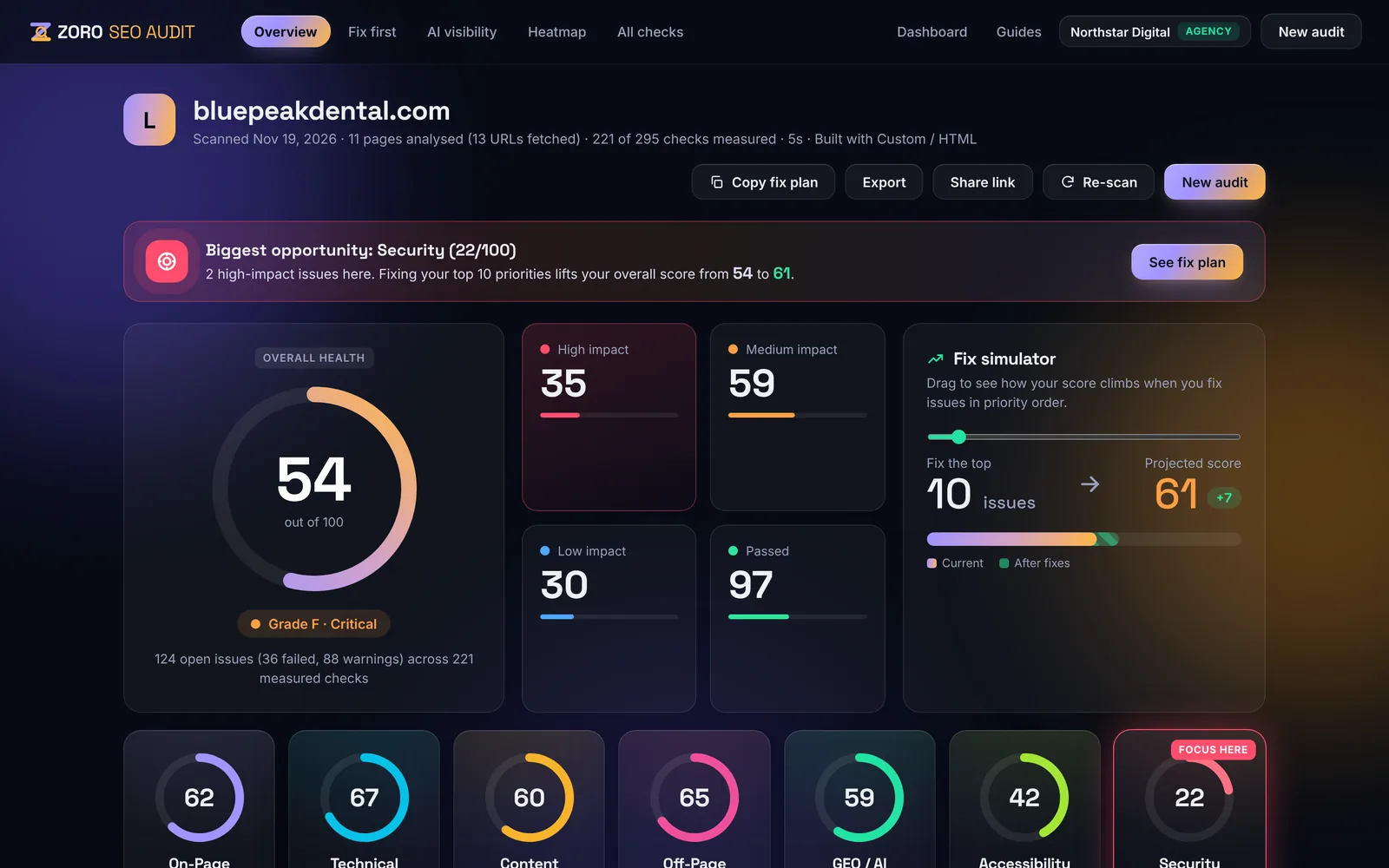
From certificate to cookie flags
HTTPS and redirects, certificate expiry and old TLS versions, HSTS, Content-Security-Policy, clickjacking protection, HttpOnly/Secure/SameSite cookies, mixed content and JavaScript libraries with known vulnerabilities.
- TLS & HTTPS — grade, expiry, old protocol versions
- Security headers — HSTS, CSP, X-Frame-Options, Referrer-Policy
- Cookies & libraries — flags and known-vulnerable versions
Free security headers grade
Try the security headers checker — no signup needed.
Website security checks
TLS grade, security headers, cookie flags, mixed content, vulnerable JavaScript libraries and clickjacking protection.
Old TLS versions disabled (1.0/1.1)
Disable TLS 1.0 and 1.1 on your server or CDN; allow only TLS 1.2 and 1.3.
TLS 1.3 supported
Enable TLS 1.3 on your server or CDN for faster, more secure connections.
TLS security grade
Raise the grade by fixing the items listed: old protocols, missing HSTS and certificate problems.
Cookies use the Secure flag
Set the Secure attribute on every cookie so it is only sent over HTTPS.
Cookies use HttpOnly
Set HttpOnly on session and authentication cookies so scripts can't read them.
Cookies set SameSite
Set SameSite=Lax (or Strict) on cookies to reduce cross-site request forgery.
Clickjacking protection
Send Content-Security-Policy frame-ancestors (or X-Frame-Options: SAMEORIGIN) to stop other sites framing yours.
Permissions-Policy header
Send a Permissions-Policy header that turns off browser features you don't use (camera, microphone, geolocation…).
Vulnerable JavaScript libraries
Upgrade the listed libraries to a version without known security vulnerabilities.
Server version disclosure
Hide software versions in Server and X-Powered-By headers.
Integrity checks on third-party scripts
Add integrity (SRI) and crossorigin attributes to scripts and styles loaded from public CDNs.
Website security basics every site should get right
Most attacks on small and mid-sized websites exploit simple misconfigurations rather than clever hacks. ZORO checks the publicly visible basics from the outside, without touching your server.
What does a website security check include?
A website security check tests the protections anyone can see from outside your site: HTTPS and the TLS version, certificate expiry, security headers such as HSTS, CSP and X-Frame-Options, cookie flags, mixed content and outdated JavaScript libraries with known vulnerabilities. ZORO runs these checks without logging in or touching your server, and gives the exact configuration to fix each one.
HTTPS, TLS and certificates
Every page should load over HTTPS with a valid certificate, HTTP should redirect permanently to HTTPS, and old protocol versions (TLS 1.0 and 1.1) should be disabled. ZORO checks certificate expiry, redirects, mixed content and the TLS versions your server accepts.
Security headers
HTTP security headers tell browsers how to protect your visitors. ZORO checks Strict-Transport-Security (HSTS), Content-Security-Policy, X-Frame-Options or frame-ancestors (clickjacking protection), X-Content-Type-Options, Referrer-Policy and Permissions-Policy — and gives the exact header lines for Nginx, Apache, Vercel, Netlify or Cloudflare.
Cookies and front-end libraries
Session cookies should be HttpOnly, Secure and use SameSite. Old versions of jQuery, Bootstrap, Angular, Lodash and other libraries carry publicly known vulnerabilities; ZORO detects the versions running on your pages and flags the risky ones.
Frequently asked questions
Is this a penetration test?
No. ZORO checks publicly visible security configuration from the outside, without attacking your site. It is a fast way to catch common misconfigurations.
How do I check if my website is secure?
Start with the public basics: valid HTTPS, a permanent HTTP-to-HTTPS redirect, modern TLS, security headers, secure cookie flags and up-to-date JavaScript libraries. ZORO checks all of these in every audit.
Does website security affect SEO?
HTTPS is a Google ranking signal, browsers warn visitors about insecure pages, and hacked sites can be removed from results. Security problems also hurt trust and conversions.
What is HSTS?
HTTP Strict Transport Security tells browsers to always use HTTPS for your domain, preventing downgrade attacks and insecure redirects.
What is a Content Security Policy?
A header that lists which sources of scripts, styles and other resources a browser may load on your pages — a strong defence against cross-site scripting.
See what’s holding your site back
Run a free audit in minutes: every SEO, AI-visibility, accessibility and security issue, ranked by impact, with the fix for your platform.